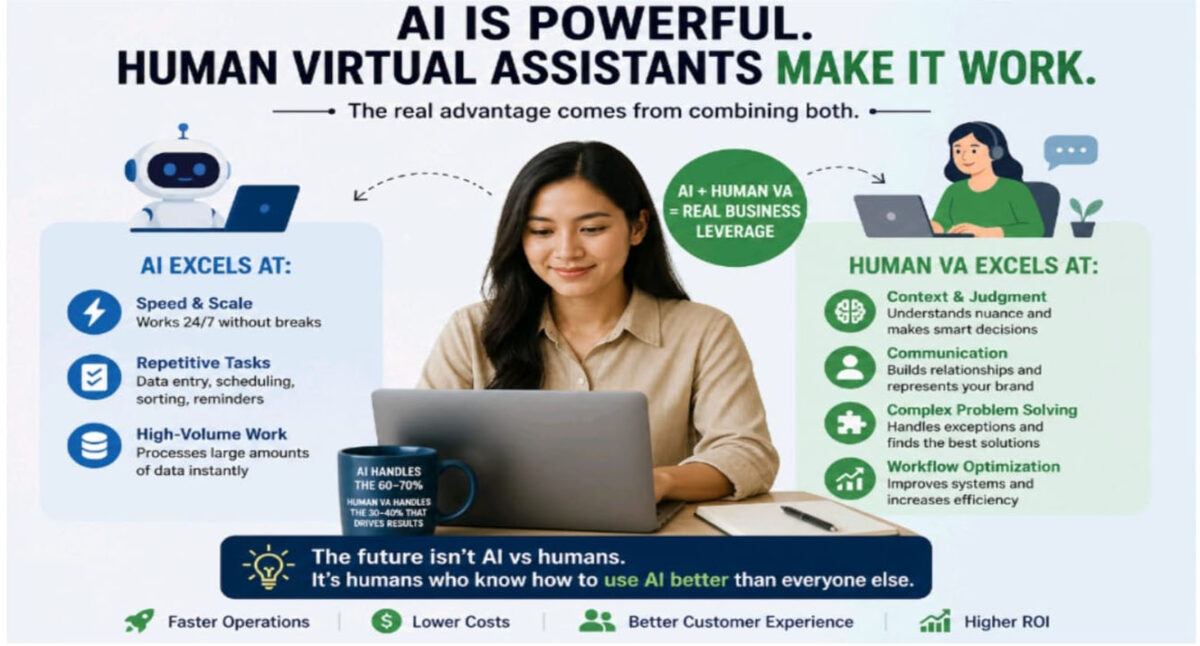
Today’s businesses face constant pressure to accelerate, reduce costs and scale efficiently. AI has become a powerful tool in this shift – but often fails to deliver real operational impact on its own.
It turns out the most effective model is not AI replacing humans. It’s AI working with a Human Virtual Assistant for automation with AI, a system that combines speed with judgment.
The Shift: From Manual Work to AI-Driven Operations
Automation used to be all about outsourcing repetitive tasks to virtual assistants. Today the AI can already do a lot of that heavy lifting – emails, scheduling, data entry, even basic customer support.
But that hasn’t made human assistants obsolete. Instead, it has raised their standing.
Human Virtual Assistant for Automating with AI is no more just executing tasks , it manages , optimizes and supervises AI driven workflows . They connect the dots from pure automation to actual business results.
Why AI Alone Isn’t Enough
AI excels at:
- Speed and around-the-clock availability
- Managing large data volumes
- Repeating, rule-based task handling
But it has problems with:
- Uncertainty and evolving situations
- Contextual decision-making
- Personalization and brand voice
- Establishing Trust in Client Relations
There is where human oversight comes into play.
When the human layer is absent, businesses can experience problems such as wrong outputs, poor customer experiences, and low ROI from their automation tools.
The Role of a Human Virtual Assistant in AI Automation
Human Virtual Assistant for AI automation enhances automation through:
1. Using AI Tools
They own tools that manage inboxes, schedule meetings, update CRMs, and do customer support, ensuring the results are correct and relevant.
2. Exceptions handling
AI can take over 60-70% of routine work. The rest – 30–40% – edge cases, escalations, complex scenarios, needs human judgment.
3. Brand Voice Maintenance
Communication needs to be consistent. Human VAs edit AI-generated content to meet tone, intent, and the expectations of the audience.
4. Workflow Enhancements
They don’t just use systems, they optimize them. They improve prompts, automate better processes and reduce waste over time.
5. Developing Relationships
Client communication, follow-ups, and relationship management still depend a lot on empathy and trust—things where humans do better than AI.
Real Business Impact
When businesses adopt a Human Virtual Assistant for automating using AI, they typically see:
- Faster operations without sacrificing quality
- Lower operational costs compared to full in-house teams
- Improved customer experience
- Better decision-making through human oversight
- Higher ROI from AI investments
Instead of fragmented tools, businesses get a coordinated system that actually works.
Businesses get an integrated system that actually works, rather than disconnected tools.
Common Mistake: “AI Will Replace Everything”
Faster operations without sacrificing quality
Lower operational costs compared to full in-house teams
Improved customer experience
Better decision-making through human oversight
Higher ROI from AI investments
Instead of fragmented tools, businesses get a coordinated system that actually works.
Many companies try to go fully automated and they don’t get results. Why?
They:
- Deploy AI without clear key performance indicators (KPIs)
- Complicated workflow use standard tools
- Training and change management? Forget it.
- Ignore the need for human oversight
The result is under-utilised systems, poor outputs and wasted investment.
The Winning Model: AI + Human Virtual Assistant
- The best setup is simple:
- AI deals with: repetitive, high-volume, rule-based tasks
- Human VA does strategy, exceptions, communication, and optimization
- This mixed approach guarantees efficiency and reliability.
- The future of businesses’ operations
- Future will have more need for Human Virtual Assistant for automating using AI.
As AI tools get more powerful:
- The routine work will continue to shrink
- The human roles will evolve to oversight and decision making
- Companies will focus on results rather than hours worked
Virtual assistants to operate AI systems will become mandatory not optional.
Final Thoughts
Automation is not about replacing humans, it’s about augmenting humans.A Human Virtual Assistant for AI-powered automation makes automation an operational advantage, not just a tool. This hybrid model allows early adopters to move faster, operate smarter, and scale more effectively than those relying solely on AI.