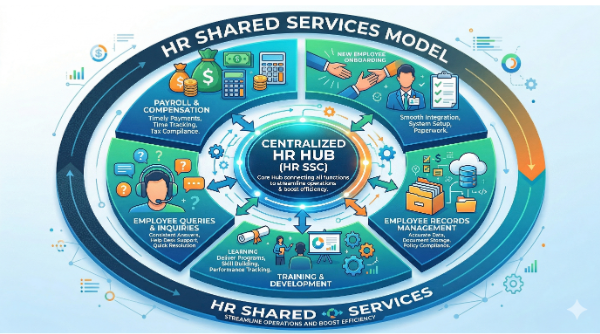
Companies need a way to handle tasks related to employees quickly and effectively without losing the personal touch in today’s fast-paced business world. This is exactly where HR shared services come in. Businesses can improve speed, accuracy, and visibility by putting all of their HR tasks into one streamlined system instead of spreading them out among different people and departments.
HR doesn’t just hire people and pay them anymore. Modern businesses need help with onboarding, keeping track of employee records, training, managing performance, reporting, and answering questions from employees on a daily basis. A well-organized HR shared services model lets companies handle all of these tasks from one central hub, which makes things more organized and consistent.
What HR Shared Services Means
HR shared services is a way of doing business in which all HR tasks are handled by one central team or service center. This method cuts down on duplication, streamlines the process, and makes things better for both employees and management. Instead of each department doing HR tasks on their own, one system handles them all more efficiently.
This model is especially useful for companies that are growing because it allows them to grow without making things more complicated than they need to be. It lets HR professionals or virtual assistants handle tasks related to employees while leaders focus on strategy, growth, and culture. One of the main reasons businesses are using HR shared services is to keep this balance.
Why Businesses Need It
Every company needs to find a balance between what its employees need and what it wants to achieve. If HR processes are slow or not always the same, it can hurt morale, productivity, and compliance. HR shared services helps fix this problem by making it easier to handle everyday HR tasks.
Businesses have better control over employee data and workflows when they centralize tasks. This means fewer mistakes, quicker responses, and better service. A shared services model that focuses on standardization and efficiency is perfect for HR tasks that are repetitive and process-driven.
Core Services Included
A full HR shared services setup can handle a lot of important tasks. These could include hiring, onboarding, processing payments, training, managing performance, helping with moving, and more. The goal is to create one dependable structure that supports the employee lifecycle from start to finish .
Other important services often include:
Responding to HR questions from workers and other interested parties.
Taking care of onboarding and offboarding.
Running training and development programs for employees.
Keeping HR records private.
Getting information and making HR reports.
Calls to check.
Going over applications.
Screening applicants and parsing resumes.
Helping new hires get used to their jobs.
These services let companies handle HR tasks without putting too much stress on their own teams. The company can make sure that important HR tasks are done consistently and professionally with shared services.
Benefits for Growing Teams
One of the best things about HR shared services is that they are efficient. Businesses save time and effort by automating tasks that are done over and over and making sure that all tasks are done the same way. This also makes it less likely that there will be mistakes in employee records, reports, and communication.
Another big plus is that you can see it. Leadership can keep an eye on HR activity in real time across different operational units with detailed analytics and reporting. This helps people who make decisions find problems early, track progress, and respond with confidence. Having real-time visibility is a big plus in a business world where competition is high.
It’s also important to keep costs down. Companies can use a centralized model that gets great results at a lower cost instead of hiring separate people for each HR task. That’s why businesses that want good help without having to pay for extra costs like HR shared services.
Role of Virtual Assistants
Virtual assistants can be very helpful when it comes to providing HR shared services. They can help with everyday HR tasks, keep records up to date, help with hiring processes, and handle communication tasks. This helps companies increase their HR capacity without having to hire a lot of people to work in-house.
The model at 24/7 Virtual Assistants is meant to give help that is both reliable and adaptable. The service is based on trained virtual assistants who work in-house and are ready to take on HR tasks with care and accuracy. Companies of all sizes can use HR shared services because they have the right mix of skills and structure.
Why Automation Matters
One important part of good HR shared services is automation. When repetitive tasks are done automatically, teams can spend more time on important things like engaging employees, making plans, and solving problems. Automation also cuts down on wait times and makes the overall experience for employees better.
For instance, a structured system can help make the steps for onboarding more consistent, send HR requests to the right person, or make reports without having to do them by hand. This makes things easier for both the HR team and the employees it works with. Automation is not just a nice-to-have in a shared services environment; it’s a key benefit.
Data Security and Trust
HR teams work with sensitive employee information every day, so it’s important to keep it private and safe. A trustworthy HR shared services provider must keep records safe, follow secure procedures, and be honest. This is very important when dealing with personal information, payroll information, and internal documents.
The service should also follow well-known rules for protecting personal data. Your page talks about how you follow the GDPR and CCPA, which gives businesses that need to handle employee information responsibly more confidence. Trust is not a choice in HR operations; it is part of the service itself.
Why Companies Choose This Model
Companies choose HR shared services because it makes it easier to manage HR for a lot of people at once. It combines cost-effectiveness, consistency, and operational control into one model. That makes it helpful for businesses that want to improve how they serve customers without making their HR structure too complicated.
The model can also change. A shared services approach can be customized to meet a business’s needs for hiring, onboarding, keeping records, training, or reporting. Because it is so flexible, HR shared services can work for new businesses, growing businesses, and established businesses.
Building a Better HR System
HR operations that are strong do more than just handle paperwork. They help people, make communication within the company better, and make the business run more smoothly. HR shared services makes those tasks more organized by creating a centralized model that is easier to manage and grow.
This method gives businesses a clear way to make HR more efficient, cut down on paperwork, and have better control over processes that involve employees. It is a good choice for businesses that need reliable HR help, better reporting, and consistent work across the whole company.
If you want to make HR easier and better at the same time, HR shared services is one of the best ways to do it.