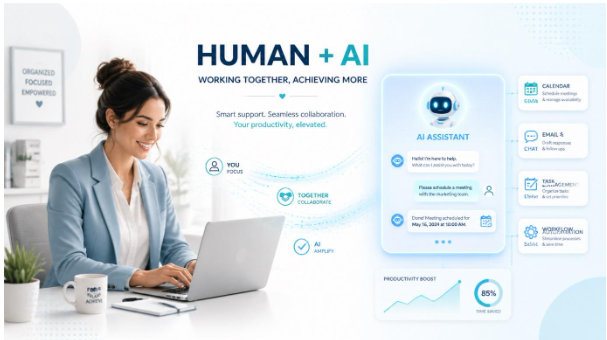
If you’ve looked into automation recently, you’ve probably heard a lot about AI taking over human jobs. But the reality most businesses are finding is that the smartest play is not to pick AI or people, but to pair them. That’s where an AI Virtual Assistant comes in, turning the game around.
Let’s break this down in a practical way, without the hype.
The Shift: From Admin Support to Strategic Support
Not so long ago, virtual assistants were primarily used for mundane admin tasks – managing emails, scheduling meetings, doing data entry. Today’s AI tools can do a large part of that work faster and cheaper.
So human assistants are a thing of the past? Not even remotely.
Instead, the role of a Virtual Assistant for AI has changed. But they’re not just doing tasks anymore—they’re becoming AI-powered operators, managing systems, refining outputs, and doing the work AI can’t quite get right.
Consider them less as assistants and more as operational partners.
What AI Does Well (And Where It Falls Short)
AI is capable of:
- Fast processing of large volumes of data
- Automation of repetitive workflow
- Providing immediate answers (24 hours a day, 7 days a week)
- Managing structured tasks such as scheduling or FAQs
But here’s the thing:
- Understanding the subtleties of communication
- Flexibility for the unexpected
- Customer Relationship Management
- Decision making based on judgment
This is where AI Virtual Assistant comes in. They are the bridge between automation and the messiness of real business.
The Hybrid Model That Works in real word situatuionss.
Today, most successful businesses are following a simple model:
AI does 60-70% of routine work
AI’s Virtual Assistant does the other
This consists of:
- Handling exceptions in case of automation failure
- Tailoring communication for customers
- AI Content Editing and Enhancing
- Orchestration of workflows across tools and teams
AI doesn’t replace humans; it makes skilled assistants more valuable, not less.
Real Business Use Cases
Let’s take a look at how this works in day-to-day operations.
1. Customer Service
AI can answer common questions immediately. “But when a customer has a unique issue or a customer is frustrated, you need a human.
What can a Virtual Assistant for AI do:
Step up to escalations
Be empathetic and stay true to the brand tone
Answer difficult questions
2. Lead and Sales Management
AI can qualify leads and follow up. But closing deals often requires context and relationship building.
Your assistant will be able to:
- Customize outreach
- Carry out negotiations
- Handle high-value leads
3. Operations and Admin
AI can automate reminders and workflow. But businesses don’t always behave predictably.
A Virtual Assistant for AI guarantees:
- The processes are going fine
- Exceptions are handled promptly
- Systems remain aligned to actual business needs
Why it matters to small and medium businesses
If you’re running a growing business, you’re always juggling:
Quality Cost Effectiveness
Not every role can afford to hire full-time staff. But over-reliance on automation can have a negative impact on customer experience and decision-making.
This is where a Virtual Assistant for AI comes in.
You receive:
- AI’s speed and scalability
- The human capacity for insight and adaptability
- All without the burden of big teams
The ROI Angle (What You Actually Gain)
This hybrid approach offers significant rewards when done well:
Less manual work
Quick response times
Cheaper per task
Improved customer experience
More consistent running
“The key is not just using AI, but using it well, with a human layer on top.
Common Mistake to Avoid
A common mistake businesses make:
They have AI tools and expect instant results, without changing how work is done.
What did happen?
Adoption poor
Low confidence in AI output
Low/no ROI
An AI Virtual Assistant protects you from this by:
- Adding AI to your current workflows
- Performance monitoring
- Adjusting process as needed
In short, they ensure your investment pays for itself.
Conclusuion
If you’re thinking about AI for your business, don’t ask:
“Do I replace people with AI? Make this question instead:
“Where can I find the right human support for AI?” Because the winning formula isn’t automation. It’s automation + intelligence. Powered by humans. And that is exactly what an AI Virtual Assistant brings to the table.