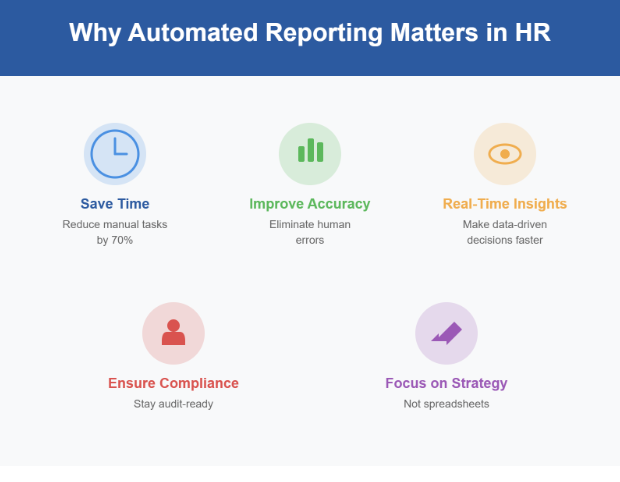
Automated reporting takes the place of manually working with spreadsheets, copying and pasting, and chasing down emails with predefined, rule-based workflows that run on their own. This means that in Human Resources automation, HR data goes straight from core systems (HRIS, payroll, ATS, performance tools) into dashboards and reports without needing to be touched by people over and over again. HR virtual assistants sit on top of these systems and make sure that HR teams get the right reports at the right time by pulling, cleaning, and distributing data.
Core benefits for big organisations
Less work to do by hand: Automated reporting cuts down on tasks that need to be done over and over again, like getting data sets, putting numbers into templates, and putting together monthly HR packs. HR virtual assistants can set up these tasks to run on a schedule, which frees up HR staff to focus on strategic workforce planning, talent development, and change initiatives.
More trust and fewer mistakes: Human Resources automation makes sure that the same data is pulled from the same sources in the same way every cycle. This cuts down on the mistakes and inconsistencies that are common in manual reports. When HR virtual assistants check fields and point out problems, leaders feel better about headcount, attrition, payroll, and compliance metrics.
Faster decision-making: Automated reporting pipelines let HR and business leaders see KPIs like hiring funnel health, time-to-fill, turnover trends, and engagement scores almost in real time, instead of having to wait weeks for manual updates. HR virtual assistants can send these insights through chat or email without managers having to ask for a report. This way, key changes or alerts are always at the top of their inbox.
How HR virtual assistants fit into Human Resources automation
HR virtual assistants are like chat rooms and workflow hubs that connect employees, managers, and HR systems. They can answer HR questions, help employees fill out forms, collect data, and start automation steps that eventually go into reporting processes. In Human Resources automation, this lets HR virtual assistants standardize how they gather information, like leave, benefits, onboarding tasks, and performance feedback. This makes the data used for reporting more accurate and consistent.
Data capture at the source: HR virtual assistants use chat to collect structured inputs for leave requests, policy questions, onboarding checklists, and performance notes. This makes sure that the data is clean and easy for machines to read for reporting. This cuts down on back-and-forth emails and makes things clearer, which directly improves the results of Human Resources automation.
Automated workflows: The assistant sends the data to HR systems, updates records, and sends approvals or reminders without anyone having to do anything. These automated steps make full audit trails, which can be turned into compliance and SLA reports with very little extra work.
Self-service analytics: In a big company, HR virtual assistants can answer requests in plain English like “show attrition by region this quarter” or “give me a diversity report for Engineering.” They can pull data from reporting tools and send back charts or key figures. This self-service layer makes it easier for HR analysts and central BI teams to get reports.
Strategic advantages for big organisations
Scalability across regions and business units: Once the workflows and templates for Human Resources automation are set up, automated reporting can be used all over the world with the same metrics and definitions. HR virtual assistants make sure that all local HR teams follow the same rules for collecting and escalating data, while still allowing for regional differences.
More compliance and audit readiness: Automated reporting in HR makes it easier to keep track of things like required training, policy acknowledgments, contract expirations, visa status, and other compliance metrics with time-stamped logs. HR virtual assistants can remind employees to do what they need to do, keep track of their responses, and make compliance reports available to auditors or regulators whenever they need them.
Better employee experience: Employees don’t have to wait days for basic information about their pay, benefits, or leave balances anymore because HR virtual assistants can answer questions right away and handle routine requests automatically. The interactions recorded in this process go into sentiment and service-level reports that help HR keep track of and improve the quality of support.
Example: automated HR reporting in practice
Think about a company with 20,000 employees that has to manually run monthly reports on people. HR business partners ask local HR teams for spreadsheets on the number of employees, the number of people who leave, open positions, and training completion. They then combine all of this information into a master file, often staying up late to do so before executive reviews. With Human Resources automation, data from the HRIS, ATS, and learning platforms goes to a central warehouse. There, automated reporting jobs make dashboards and packs overnight. An HR virtual assistant then tells leaders that new reports are ready, points out important changes (like “attrition increased 2% in Region APAC”), and answers questions in real time. The end result is an HR team that is smaller and more strategic. Instead of making reports, they spend their time explaining insights and making plans for the workforce.