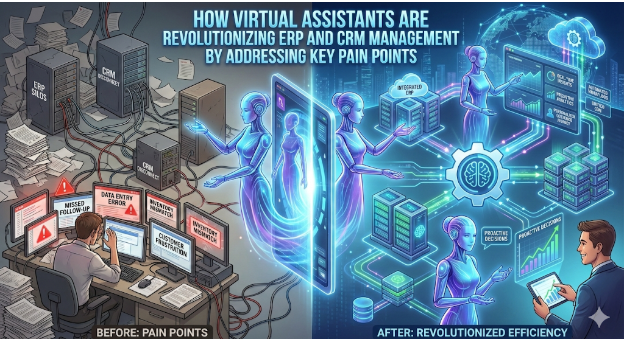
Keeping business data accurate and up to date is a silent battle that executives in every growing company face behind the scenes. The problem is the same whether it’s in an ERP (Enterprise Resource Planning) system that coordinates core operations or a CRM (Customer Relationship Management) platform that keeps track of leads and clients. When these systems aren’t properly maintained, decisions stall, teams lose alignment, and growth slows down.
But there is a quiet revolution going on: the rise of virtual assistants to help with ERP and CRM management. It’s not just about hiring someone else to do administrative work; it’s also about coming up with new ways for businesses to run their digital operations in a smart, efficient, and cost-effective way.
The Unspoken Pain Points of System Management
Let’s face it — even the best ERP or CRM system is only as good as the data inside it. Businesses invest heavily in top-tier software like Salesforce, Zoho, HubSpot, or SAP, expecting to see measurable efficiency and better customer tracking. Yet, in many small and mid-sized organizations, the reality looks different.
Employees often find themselves lagging behind with data entry. Their primary roles — sales, operations, or support — already demand full attention. Updating CRM fields, recording follow-ups, or logging expenses into an ERP becomes another time-consuming task piled on their to-do list. Over time, this leads to:
- Low adoption rates: Many staff members avoid or delay updates.
- Data inaccuracy: Missing, outdated, or duplicated records make reports unreliable.
- Inconsistent reporting: Managers can’t trust insights from broken or incomplete dashboards.
- Employee frustration: Those handling both operations and system updates often feel overburdened.
These problems compound as the business grows. Decisions start to rely more on gut feeling than data — defeating the very purpose of having these powerful systems.
The Cost of Traditional Solutions
Let’s be honest: no ERP or CRM system is any better than the data it has. Companies spend a lot of money on high-quality software like Salesforce, Zoho, HubSpot, or SAP because they want to see measurable improvements in efficiency and customer tracking. But in a lot of small and medium-sized businesses, things are different.
Workers often fall behind when it comes to entering data. Their main jobs—sales, operations, or support—already require all of their attention. Updating CRM fields, keeping track of follow-ups, or entering expenses into an ERP are all things that take up more of their time. This leads to:
Low rates of adoption: A lot of staff members put off or skip updates.
Data inaccuracy: Reports are not reliable when records are missing, out of date, or duplicated.
Inconsistent reporting: Managers can’t trust information from dashboards that don’t work or have missing data.
Frustration among employees: People who have to do both core operations of the company and system updates often feel like they have too much on their plate.
As the business grows, these problems get worse. People start to make decisions based more on gut feelings than on data, which is the opposite of what these powerful systems are meant to do.
Virtual Assistants: Bridging the Efficiency Gap
This is where virtual assistants (VAs) come in as a smart and scalable answer. A virtual assistant who knows how to manage ERP or Manage CRM can do all of the important backend tasks from a distance, with accuracy and dependability.
These helpers only care about keeping your CRM or ERP environment clean, up to date, and ready to work. Their job usually involves entering and updating leads, contacts, invoices, and reports.
- Cleaning up data that is the same, old, or inconsistent.
- Managing lead scores, funnels, and pipelines in a CRM.
- Changing purchase orders, inventory, and accounts in ERP systems.
- Making management reports on a regular basis or on request.
- Making automations, triggers, and dashboards easier to use.
They don’t have to deal with competing priorities because their only job is to keep the system running smoothly. This is something that regular employees can’t always avoid.
The end result is reliable data and accountable systems, both of which make businesses run much better over time.
Accuracy, Consistency, and Control — The Three Key Benefits
A virtual assistant can do a lot more than just keep your files up to date. Let’s look at the real benefits for businesses.
1. More accurate data
Virtual assistants bring much-needed consistency to your data because they work in a set way. No more misspelled client names, invoices that don’t match, or sales records that aren’t full. Automated processes and analytics tools can finally work at their best when they have accurate data. This means they can give you reliable insights.
2. Better collaboration and reporting
Collaboration gets better when everyone in the company uses the same, up-to-date source of truth. Department heads can ask the assistant for reports or analytical summaries without worrying about them not being accurate. Through well-made dashboards, the leadership team can see clearly how sales are going, how much inventory is on hand, how long projects will take, and how much money they will make.
3. Making the best use of time and resources
Sales and operations staff can spend less time updating records—30–40% of their time—and more time on tasks that actually bring in money, like getting new clients, closing deals, and delivering results. Companies can focus on their main business goals by giving a virtual assistant the job of updating the backend.
How This Works in Practice
Picture a trading company of medium size that uses Zoho CRM and Tally-based ERP. The sales team has trouble getting updates on time, which means that management reports have data that is missing or wrong.
The company makes things easier by hiring a dedicated CRM virtual assistant:
- Through chat or email, each salesperson sends the virtual assistant notes, call outcomes, and leads every day.
- The assistant keeps track of these details in the CRM, tags the stages correctly, and updates conversions.
- Weekly reports are made and sent to management automatically.
- Based on those records, the ERP assistant updates invoices, order statuses, and payment reconciliations.
- The business sees a real difference in a month: better coordination, more accurate reporting, and faster decision-making, all without hiring a full-time staff.
A Cost-Effective Strategy with Strategic Impact
From financial point of view of a company, virtual assistants make perfect sense. A skilled VA costs lessser compared to hiring someone to work on-site, but they are just as reliable, if not more so. You only pay for the hours or results you need. Also, most VAs already know how to use cloud-based CRMs and ERPs, so they don’t need much training.
Small businesses can run like big businesses—systematically, efficiently, and intelligently—thanks to this scalability. Virtual assistants also learn how to use new tools quickly with the help of guided training. Your company can customize workflows to fit your structure, no matter if you use SAP, Zoho, HubSpot, or Odoo.
Empowering Leadership with Real-Time Insights
The most underrated benefit is that virtual assistants give leaders more power. Managers and owners don’t have to go through reports or deal with complicated dashboards anymore. The assistant can make a polished report in just a few hours with the simple command, “Show me this week’s sales pipeline summary.”
In short, the leadership team can now focus on making big decisions instead of doing operational data work. Every successful business needs this link between raw data and useful information.
The Future of Data Management is Hybrid
The next level of business efficiency will come from combining automation with virtual help from people as AI tools and virtual collaboration platforms get better. AI can take care of repetitive tasks, and human assistants can make sure that everything is in the right context, is accurate, and is formatted for making decisions. It is a hybrid model, and it is quickly becoming the new normal for businesses that use data.
Final Thoughts
It doesn’t have to be hard or time-consuming to run ERP and CRM systems. The secret is to give the right tasks to the right people, or in this case, the right virtual teams. Virtual assistants are the best choice because they are cheap, accurate, and know how to use the system.
Your business can finally focus on what really matters—growth, relationships, and making smart choices—when you add VAs to your workflow. The smartest companies in the digital transformation era aren’t just automating work; they’re making it better by combining human intelligence with virtual efficiency.